About Me

My name is Alexandra Skouras. I am 23 years old and a first year participant in the Auxiliares de Conversación Language Assistants Program.

In May 2019 I graduated from Hood College in Frederick, Maryland in the United States of America. I received a Bachelors of Arts degree with my two majors: Spanish and Biology. I also studied a minor in piano performance. Many people thought I was crazy for undertaking such a busy and difficult schedule, but I loved the satisfaction of receiving a widespread and diverse education through my different fields. For this reason, I decided to structure my final project around music. I incorporated my knowledge of music into a classroom setting in order to reinforce the ideas of a natural science class. I think music is a valuable tool for helping students achieve different types of learning. It also allows them to access and strengthen different parts of their brains in a fun, interactive manner.

I was born into an ethnically diverse and unique family. My mother was born in South Korea and was adopted by an American couple from Pennsylvania when she was 13 years old. My father was born in Greece and emigrated to the United States in his teenage years. Both of my parents maintained large portions of their cultures and heritages, which allowed me to grow up understanding and feeling deeply connected to my family’s history and background, despite having been born in the United States.

When I was 15 years old, I completed 4ESO in Barcelona, Spain through a study abroad program called AFS. It was a difficult experience because I lived away from the comfort and familiarity of my home for the duration of ten months. I completed my classes in Catalan and communicated with my host family in Spanish. This sparked yet another desire for me to explore and learn about cultures other than my own. I am so thrilled to be participating in this program where I am able to combine my pay experiences and apply what I learned. I think having experienced studying another language in another country, I have a deeper understanding of my students’ needs and more patience in helping them learn and acquire skills to continue learning.
Overall Impressions

I think the Language Assistants program is such a valuable asset of education in Spain. It allows LA’s to experience and learn from teachers of ESL. It allows teachers to hear from LA’s and determine how their students can have more effective lessons in English. It allows students to experience a change in the classroom setting and communicate with native English speakers. I would highly recommend this program to anyone eager to work with children, expand their worldly views, and teach in another country!

Highlights

  • First and foremost, the experience itself is extremely rewarding because you are directly witnessing the growth of students both emotionally and academically. I love the relationships I have with my students. They remember small details of my life and are eager to tell me about theirs.
  • The structure of my schedule changes allowing me to work with different age groups. I am able to learn about how students learn during different phases of their lives. Some teaching strategies are more effective when applied to classes of younger students and vice versa. It’s amazing to gain a well rounded understanding of students’ needs and act accordingly.
  • Coming from a unique background myself, I feel I’ve been able to show my students that they can travel and accomplish anything. I tell them how I have been able to travel and learn because of how dedicate I was to my own education. I love hearing my students say that they want to be teachers in the future as well.
  • One of my favorite experiences was being able to sing at my school’s Christmas holiday program. I love music and constantly try to incorporate it into my classes. My students know I love to sing, and were thrilled to see me take the stage before they performed their dances!

Experiences from other LA’s at my school

“I’ve been very fortunate to work at Juan Sebastian Elcano for almost three academic years, being surrounded not only by amazing students, but also some awesome teachers! It’s rewarding seeing the kids grow up and learn more each year, as well having a positive influence on their lives.” -Andrea, 3rd year as an LA

“I was surprised to be placed in a primary school as I didn’t feel equipped to handle students of this age. I was impressed to see their ability to learn despite not having a very high level of English. The students are responsive and bright, and seeing them learn has to be the best part of the job. It’s helped me discover new methods of learning and has challenged me to adopt new teaching strategies to be able to effectively meet the needs of different students. I hope to return next year!” -Danielle, 1st year as an LA

Teaching Experience

I am working in a bilingual primary school. The school has infantil classes, but me and the other Language Assistants only teach first through sixth grade (approximately ages 6-13).

My coordinator is extremely organized. Since there are several LA’s at my school, she created schedules for 3 trimesters of the school year. Each trimester, we work with a different age group. My first trimester was 1st and 2nd grade, my second trimester 3rd and 4th, and my third trimester will be 5th and 6th grade. She created this structure so that we would be able to get to know all of the students in the school. I thought it would be difficult to learn so many students’ names, but working with them in small groups made it so much easier. I also love making the connection with the students. When they are more comfortable and familiar with you, they tend to respond better to your lesson material.

In my school, the LA’s only work in three different classes: English, Social Sciences, and Natural Sciences. These classes are those taught in English. The teacher of each class has the ability to designate our responsibilities. Some of the teachers will have us simply help maintain control in the classroom, make sure students are staying on track, helping them with whatever activities are being completed. Most teachers have us take groups of 2-5 students into the hallway to work individually with smaller groups. We generally complete the same task as the students in the classroom, but the smaller group allows the LA to witness the progress of the students and keep them on task. This also helps if students have questions. Sometimes they might refrain from asking for clarity in front of the entire class, but will not hesitate in a small group setting.

Goals for Self and Learners

Personal Goals: I hope to gain a better understanding of students needs. I think child development is so important and this is a pivotal age for instilling an interest in school. I hope to show the students that English is a valuable skill that they will be able to use in their personal and professional lives. I also aim to demonstrate how improving on their English can simply help them better communicate with LA’s.

Goals for Students: I love the structure of the program at my school, because I am generally given an individual class in every period. That means that by the end of the 45 minute class, it’s quite easy to recognize how much of the task the students have been able to accomplish. As far as year long goals go, I hope to continue establishing a reasonable fun to work ratio. I always conduct my small groups with enthusiasm and some reward tactics. However, my students are starting to learn that unless they accomplish the task at hand, the small group cannot function.

Halloween Activities

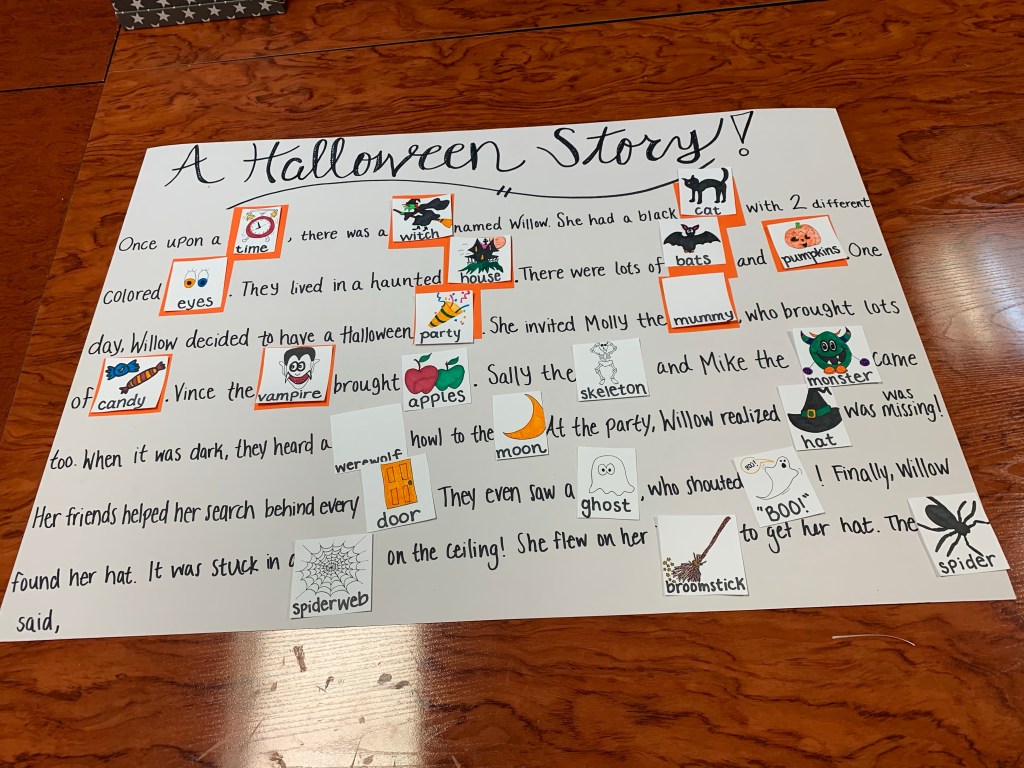
I was assigned the task of giving a Halloween presentation to students in first through third grade. I had to find an activity that would work for all age groups, so I decided to make an original project. I created the above poster with an original story about Halloween. The pictures were small “flash cards,” and before the presentation, each student in the class was given a card. The poster was hung on the blackboard where all of the students could see it. There was an accompanying PowerPoint, which told the story as it’s presented on the poster. When the PowerPoint showed a picture, one student would have the associated flash card, and come to the board to sticky tac the picture onto the poster board.

I chose this activity because it allowed the students to learn about a holiday in the United States which automatically made it an engaging topic. Each student was able to and eager to participate. Finally, they were able to learn vocabulary relevant to Halloween but also applicable to other situations.
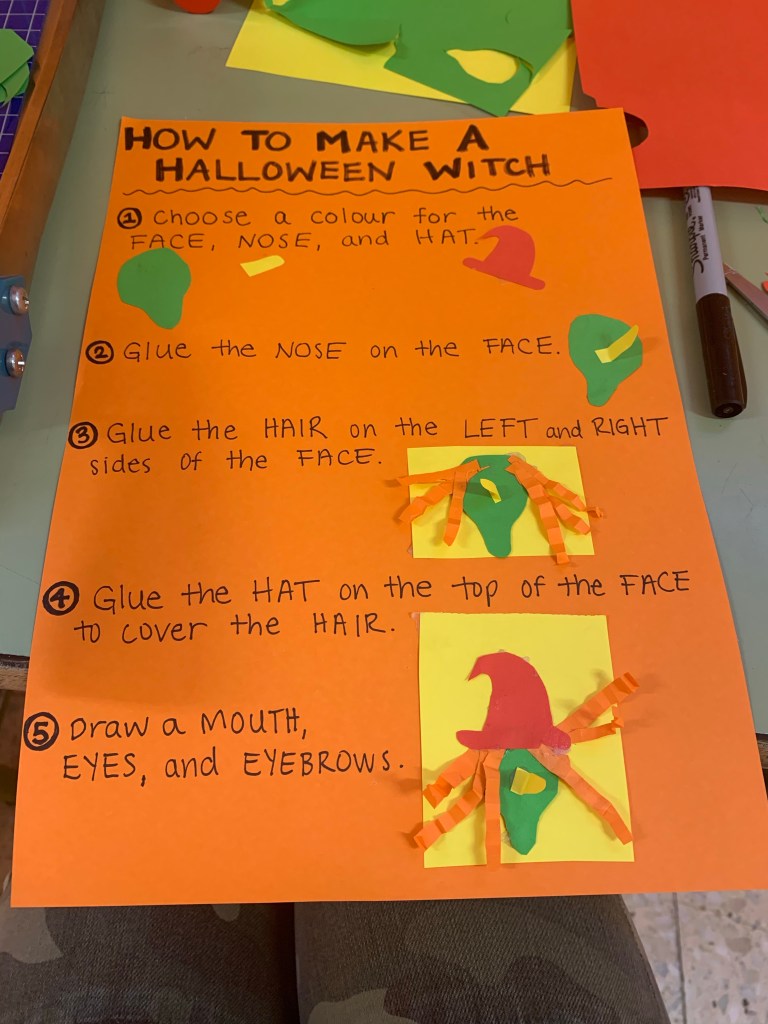
I completed an art project with my second grade students where we made a witch. This was the instruction worksheet. The students had to read the instructions to be able to complete the activity on their own, but the small pictures indicated exactly what was to be completed.
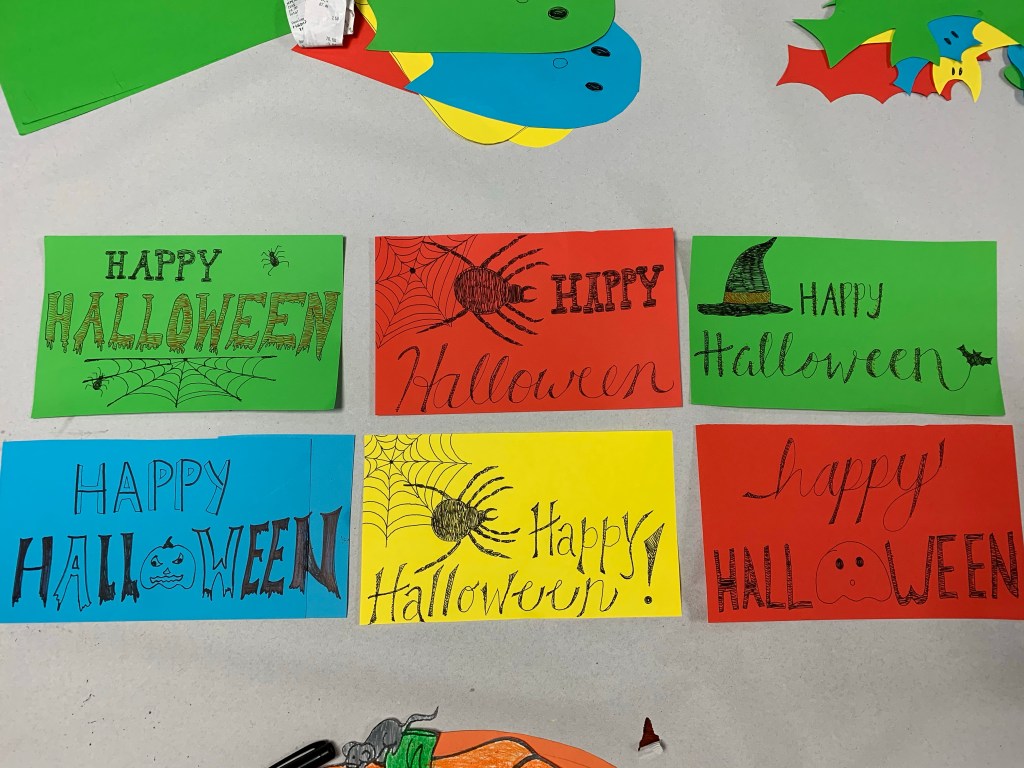
Finally, I was able to simply doodle with some of them and chat about what Halloween in the United States is like. with the above drawings, we learned some vocabulary such as spider, spiderweb, hat, pumpkin, and ghost. The students seemed to really enjoy the spooky theme and the ability to have some fun and be creative!

Expectations for the Program

I anticipated it would be difficult to get accustomed to teaching another language in a new school without much formal training. I was fortunate enough to have an extremely helpful and welcoming staff at my side, and other language assistants who knew the rules and regulations of the school with great familiarity.

I wondered how the children would react to my presence in a classroom. I told myself from the very beginning of the program that I would always strive to be a source of positivity for the students. I didn’t know if it would be difficult to accomplish that goal while making sure the children viewed me with respect and someone they needed to listen to. I’ve found that learning the needs of students really helps with maintaining discipline but also making sure there is some aspect of the lesson that they enjoy.

School Placement

I am working in a school called Juan Sebastian Elcano in Usera. I love working in the central part of the city. Many of my students take the metro to school, I often end up sitting next to some of my students and their parents on the metro!

Usera is a notoriously diverse area of Madrid, so my students come from very ethnically diverse backgrounds. I think it’s amazing to have a class with such a broad range of family backgrounds. My students are a mix of Chinese, Japanese, Ecuadorian, Bolivian, Romanian, among many others. It’s important for children to grow up around other children who don’t look or speak like them. I was concerned that my students wouldn’t understand my background since I look Asian but speak American English. They have surprised me with their open mindedness, and I credit the location of the school for putting them into contact with such diversity.

The school is relatively small so it has been easy to get to know other staff members, both English speaking and not. Everyone in my experience has been helpful and respectful. Ultimately, the goal in any school is to promote students’ learning, and I’m glad to be working in a school where that has so much focus and priority.